Chattanooga Tree Project Plants + Cares for City Trees
Urban Understory
Written by Ansley Barry
In the sweltering summer heat, sweat drips down the necks of residents as they walk along the bustling streets of Chattanooga, Tennessee in search of shade. While some are able to find reprieve amongst the tree-lined paths, there are many areas around the city that are noticeably lacking these resources.
To address this problem, the City of Chattanooga was awarded a $6 million dollar grant from the United States Forest Service in April 2024 to fund the Chattanooga Tree Project (CTP). This project is dedicated to planting thousands of native tree species to increase canopy coverage across the city in neighborhoods that need them the most.
“From start to finish, I’ve spent a lot of my time mapping forest loss, and the data has shown that over the years, we’re losing forests in Chattanooga,” said Mimi White, graduate research assistant for the UTC Interdisciplinary Geospatial Technologies (IGT) lab. “A lot of the trees that we’re planting, we’re planting in neighborhoods that have lost their tree cover a long time ago,… so it’s really beautiful to walk through a neighborhood in Chattanooga and see the new trees that have been planted and know that the people who live in these neighborhoods are going to be able to enjoy the benefits that come with having a healthy urban forest years down the road.”
In collaboration with the City of Chattanooga’s Natural Resource and Forestry departments, the CTP’s success also relies on several partners across the city, including the Southeast Conservation Corps, the non-profit Green Spaces, and the University of Tennessee at Chattanooga’s IGT Lab, who created maps depicting tree canopy coverage across the city, showcasing which areas are most in need of vegetation. By comparing these with other maps, they were able to see trends in that neighborhoods with the least amount of tree canopy coverage were congruent with areas that are low-income and experience the highest heat index.
During the program’s first season, from January to April 2025, the project planted approximately 900 trees across the city, including 300 in the residential area of Orchard Knob. This coming season, CTP plans to more than double its residential plantings. From November to January, the goal is to plant 400 trees in Ridgedale and another 400 trees in East Lake between February and April.
“In a way, we are kind of bringing nature toward the city rather than bringing people out toward nature, which is a really practical way of getting people to actually see nature and appreciate it,” said Connor Schoenl, member of the Green Space’s Understory workforce crew.
All of the trees planted by CTP are native species sourced from regional nurseries, adding to the ecological benefits of the plantings. Alongside increased stormwater retention, better air quality, reduced urban heat island effect, and reduced energy consumption, these species increase habitat for native wildlife in the city.
Overall, the goal of the project is to have a 90% survivability rate of all trees planted. Only a handful of the trees already planted have not survived for various reasons including poor soil, heat shock, improper planting by volunteers, and even human sabotage from those unhappy with the plantings. Despite the current success, development remains one of the top concerns for the project.
The city is already experiencing an influx of incoming residents, which is expected to increase with the new designation of Chattanooga as a National Park City. To offer a layer of protection to the city’s greenness, the Chattanooga City Council approved a tree ordinance, spearheaded by Chattanooga Mayor Tim Kelly, which dictates that for every acre of land developed, a 36-inch tree caliber (roughly 18 trees) must remain or be replanted on the property.
“The idea is that our tree canopy is super important. It’s part of who we are as a National Park City, so we have to protect it and make sure it continues to not only stay at the current level but to grow,” said Kelly.
Alongside development, the most prevalent concern is funding. As federal funding continues to be redistributed, those relying on grants feel a sense of uncertainty about the future of their projects.
“In March, when everything was getting slashed, we were 100% certain we were going to be out of work any day,” said Strok. “We just watched all these similar programs just getting completely wiped out, so we thought we were putting in resumes to other places, and nothing happened to ours. So, we made a decision in April to forget about it and press on until we hear otherwise, and that’s what we’ve done.”
Strok says that while the uncertainty lingers, he believes in the future success of the project, as the Chattanooga community has demonstrated that it is something they want. “I think one of the beauties is that no matter where you reside politically, for the most part, you believe that trees are important to the community,” said Strok.
If federal funding should cease to be provided, the staff plans to turn to other sources to keep the program going. Alongside applying for as many grants as possible, the CTP intends to host public events such as holiday drives with suggested donations from various companies and individual donors across the city.
Though the project was not directly linked to the city becoming a National Park City, the two manifested around the same time, potentially aiding one another’s efforts. The designation expands Chattanooga’s recognition and credibility, which may provide a layer of protection for the project and open up funding opportunities in the future.
“We do hope that as we progress and start to seek additional grants and local funding, that us being a National Park City helps further our viability,” said Strok.
As for the future of the project, he hopes it will turn into a permanent non-profit. “In 20 years, maybe we’ll have planted 25,000 trees, and that’s the real goal,” said Strok. Overall, the hope is to “change the tree culture in Chattanooga and instill the idea that this is everybody’s responsibility and the city government is not going to come save you and plant all these trees. We have to do it together.”
Green Revival
Written by Ella Sole
Following dawn, as the fog lifts off the ground, volunteers and a trained workforce all walk down a barren Chattanooga street, shovels and saplings in hand. They have all joined together to help plant trees, in the hopes that it will not only benefit the natural landscape but also the residents whose homes are affected by environmental and societal factors that burden them.
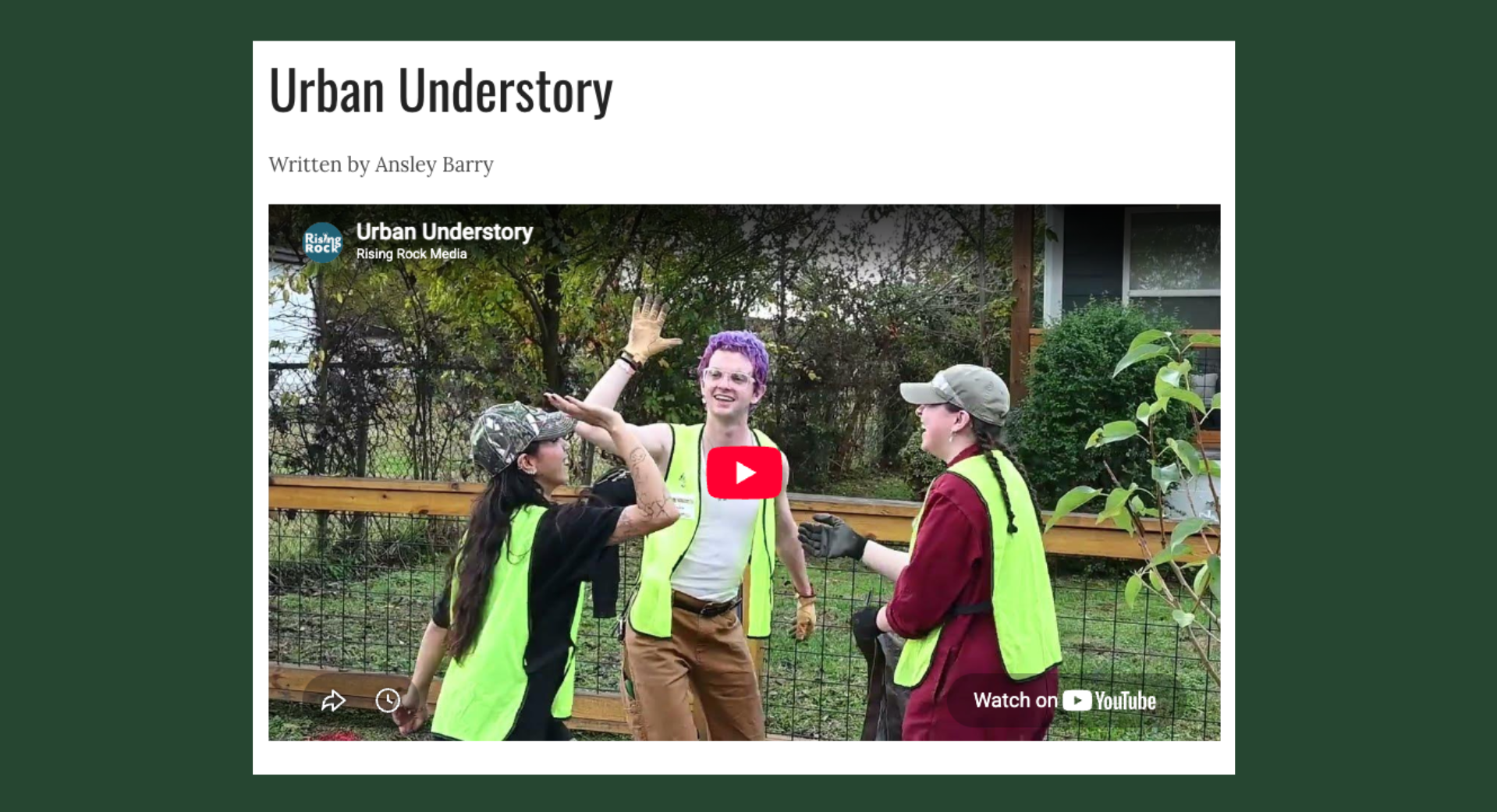
Understory, a subsector of Chattanooga Tree Project, is the leading workforce behind their efforts in planting trees around Hamilton County. Their labor is mainly directed at planting trees, but the roots run much deeper. The main pillar of Understory is community engagement, from the first interactions with homeowners to showing volunteers how to properly plant the saplings.
“Understory is really the backbone of the (Chattanooga Tree) project,” said Jimi Miller, the Director of Engagement at Understory. “They’re the ones keeping these trees alive, which is a really big proponent of tree care or planting trees that’s forgotten.”
Their efforts aren’t just limited to getting the trees planted. Most are planted in rural neighborhoods, which may have limited water sources, high traffic, or other factors that make it difficult for trees to flourish. But, with their mission to help the maintenance and longevity of the trees, most of the saplings planted continue to live and flourish in those communities.
“We’ve planted nearly 500, and we’ve only lost about five. So the proof is in the pudding,” said Miller.
The workforce consists of local residents from Chattanooga or the surrounding area. Understory trains its workers on both community involvement and tree care. The program offers knowledge about urban ecology that assists in their transition into long-term, environmentally oriented jobs.
“They’re being trained by our resident master arborist, Chris,” said Miller. “He is getting them all trained in pruning and pretty much every facet of keeping a tree alive. It’s something that we want to do forever, because it’s not education that people typically have access to. I think that it’s really important to reconnect people with nature, or just connect them for the first time, because a lot of people haven’t had much outdoor experience at all.”
Community is at the forefront of Understory’s mission, and while they want to help everyone, building that connection with the people is the first step in improving the region.
“Our team and I will engage with every single house at least three times before having a tree planted in front of it,” said Miller. “We want people to know that we’re here and we’re not going anywhere, because a big reason why people wouldn’t want a tree is that they wonder who’s going to take care of it. So we want to show up and prove that we’re going to show up in the future as well.”
Planting only native tree species, Understory’s main resources are nurseries around the state, but their main locations are centered in McMinnville, Tennessee.
“There are dozens of different nurseries in that area,” said Miller. “Per our grant, we have to order from multiple. So we really try and bounce around and make sure that we’re sharing the love.”
While Understory is a workforce with a mission to plant trees, community means everything for their goal in urban forestry. Through planting more trees in and around Chattanooga, they’re providing long-term assistance in increasing community engagement and canopy cover around the city.
“Our motto is community, opportunities, and trees. Trees come last because they’re the least important of those,” said Miller. “We’re planting saplings to provide shade, and shade gets people out of their houses, and it gets people connected. Community is really what this is all about.”